


How to calculate pizza dough with MyPizzaMentor: a step-by-step guide
How to calculate pizza dough with MyPizzaMentor: a step-by-step guide
How to calculate pizza dough with MyPizzaMentor: style and amount, yeast and fermentation, recipe, AVPN check, calendar schedule and the pro panel for pizzerias.
 By Alessio - MarketingPublished on 28.10.20267 min read

In short
- With MyPizzaMentor you calculate your pizza dough in six steps: style and amount, yeast and fermentation, recipe, AVPN check, schedule and, for pizzerias, the pro panel.
- Example: 6 Neapolitan dough balls of 250 g at 60% hydration with 16 hours of fermentation at 20 °C need 921 g flour, 552 g water, 26 g salt and 1.2 g fresh yeast.
- The schedule counts back from the time you want to bake and goes into your calendar with reminders.
- Recipe by email, link or copy: your numbers are always with you.
Calculating pizza dough isn’t magic, but there are lots of variables: hydration, salt, yeast, temperature, hours at room temperature and in the fridge. MyPizzaMentor, Pizza-Schule’s free pizza dough calculator, does the maths for you. In this guide we show you step by step how to use it and what to watch out for. If you’d like to see everything it can do first, read our introduction to MyPizzaMentor.
Tip: open the calculator in a second tab and follow the steps as you read.
Step 1: Choose style and amount

In the Style section, tap your pizza style: Neapolitan AVPN, Contemporary, Roman thin, Pala / Pinsa, Pan (teglia) or New York style. Each style sets suitable starting values for hydration, salt and weight.
In the Quantity section, enter how many dough balls you want and how much each should weigh. For Neapolitan pizza, 250 g is a good starting point; the rules allow 200 to 280 g. Pan pizza works differently: you enter the number of pans, their width and length and the grams of dough per cm². The typical range is 0.5 to 0.65 g per cm².
In the Dough section you set hydration and salt, and for New York style also oil and sugar. You can change any value with the slider or by typing in the field.
Step 2: Set yeast and fermentation
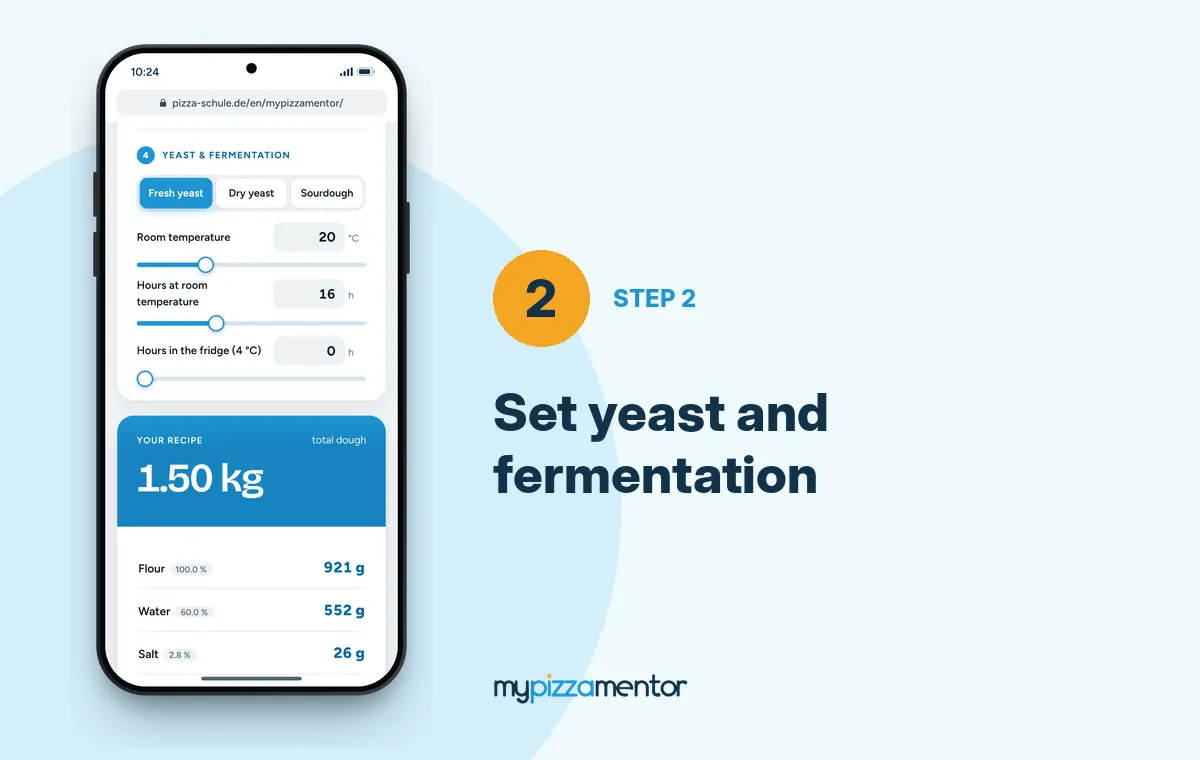
In the Yeast & fermentation section, first choose the leavening: fresh yeast, dry yeast, sourdough, biga or poolish. Then enter three values:
- Room temperature: the real temperature of your kitchen, not the one you’d like.
- Hours at room temperature: how long the dough ferments outside the fridge.
- Hours in the fridge (4 °C): cold fermentation, which makes the dough more flavourful and easier to digest.
The longer and cooler the fermentation, the less yeast you need. With biga and poolish you also set the share of flour in the preferment; the calculator then splits the recipe into two steps: the preferment first, then the final dough. With the Neapolitan AVPN style, biga and poolish are not available, because the rules require a direct dough.
Step 3: Read your recipe
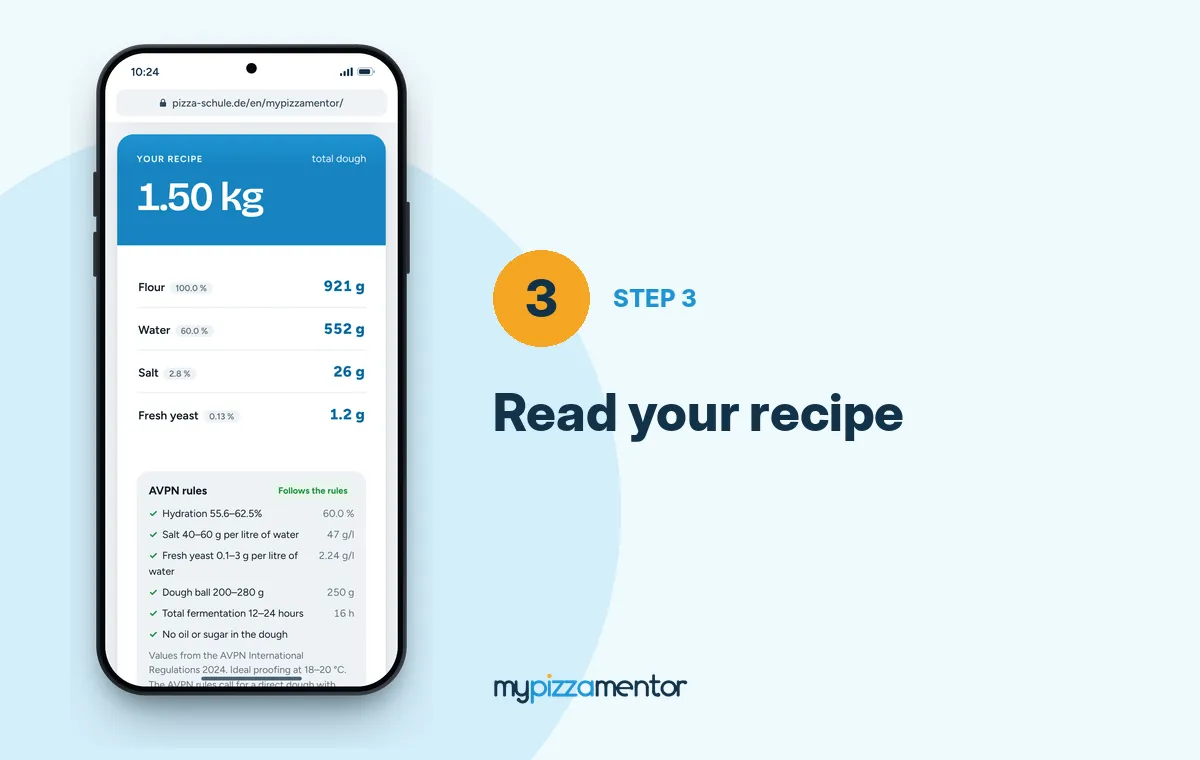
In the blue Your recipe box you’ll find the total dough at the top and each ingredient below in grams and as a percentage of the flour (baker’s percentage). An example with the default values: 6 dough balls of 250 g, 60% hydration, 2.8% salt and 16 hours at 20 °C give you:
- Flour: 921 g
- Water: 552 g
- Salt: 26 g
- Fresh yeast: 1.2 g
That’s 1.50 kg of dough in total. The yeast amounts are careful estimates: flour, the real temperature and the water change the timing. So always watch the dough, not just the clock. You can dissolve very small amounts of yeast in some of the recipe water; the calculator tells you how much of that solution to use.
Step 4: Check the AVPN rules
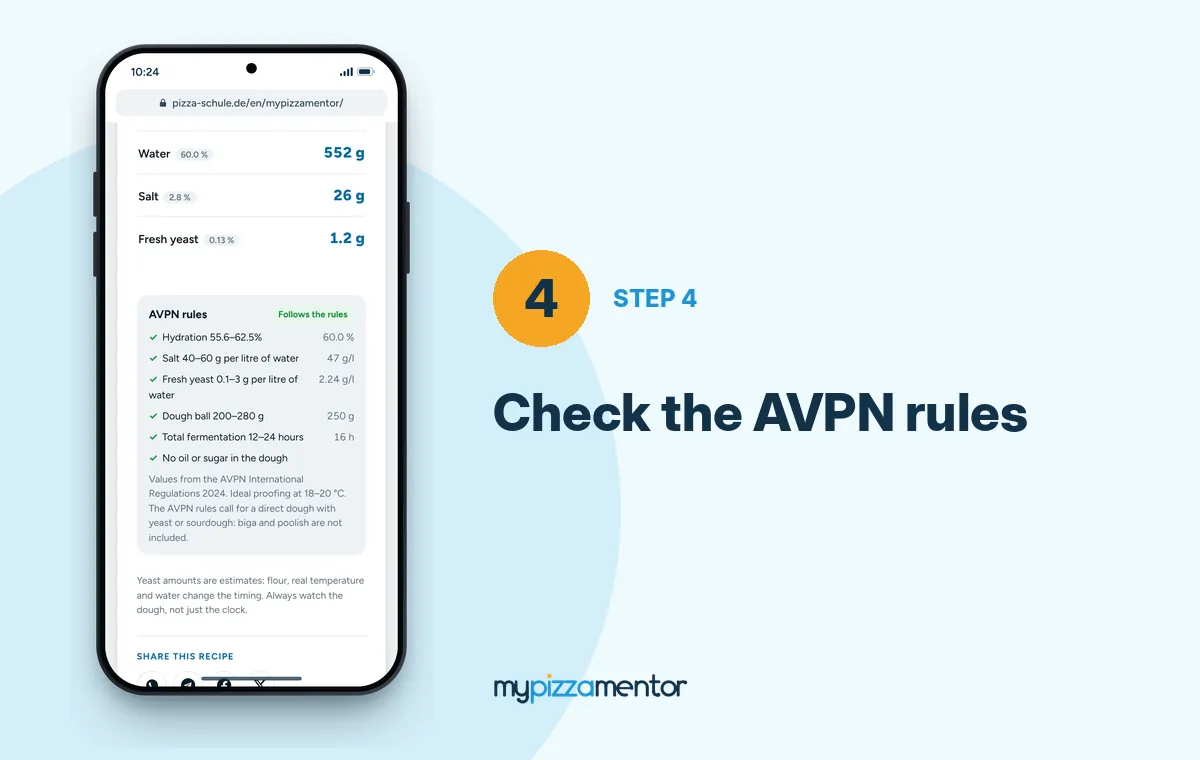
If you chose Neapolitan AVPN, the AVPN rules box appears below the recipe. It checks six points: hydration 55.6–62.5%, salt 40–60 g per litre of water, fresh yeast 0.1–3 g per litre of water, dough ball 200–280 g, total fermentation 12–24 hours, no oil and no sugar in the dough. If it says your recipe follows the rules, you’re all set. If not, you see exactly which value to adjust.
Step 5: Add the schedule to your calendar

Under Your schedule, choose when you want to bake. MyPizzaMentor counts backwards and gives you the time of every step: mixing (with the right water temperature), shaping the dough balls, into and out of the fridge if you use cold fermentation, firing up the oven, baking.
With Add to calendar, every step goes into the calendar on your phone or computer, with a reminder five minutes before. The first event also contains the recipe. Notice you’d have to mix in the middle of the night? Move some of the hours to the fridge or bake later: the schedule updates instantly.
Step 6: The pro panel for pizzerias

If you make lots of dough balls every day, open the pro panel. First enter at the top how many dough balls you make on a working day. Then choose how fast the person dividing and rounding by hand is today: experienced pizzaiolo (10 seconds per ball), average pizzaiolo (15 seconds) or beginner helper (22 seconds).
Optionally, enter the hourly cost of a helper. MyPizzaMentor then shows you:
- how many hours and working days a year dividing and rounding by hand take,
- how much time dough dividers, rounders or a line combining both save,
- how many months each machine needs to pay for itself,
- which spiral mixer, and how many batches, suit your daily amount.
The calculation assumes six working days a week.
Save and share your recipe
Want to keep your recipe? You have three options:
- By email: enter your address and confirm the link in the email. Your amounts and schedule then arrive in your inbox.
- Copy recipe: one click and the recipe is on your clipboard, ready for notes or a chat.
- Share the link: send the calculator to friends who make pizza or to colleagues at the pizzeria.
Your mentor’s tips
Below the recipe you’ll find tips that adapt to your settings. A few examples: for water temperature, use the rule of 55 (room + flour + water = 55) so the dough ends at around 24 °C. Add the salt towards the end of mixing. For many hours in the fridge you need a strong flour, around W 280–350. And above 26 °C room temperature yeast works fast: use very cold water and shorten the time outside the fridge. If you don’t need the tips, you can switch them off.
Common mistakes when calculating pizza dough
- Entering the wrong room temperature. Measure it where the dough sits: two degrees make a big difference.
- Fermentation that’s too short. Under 6 hours the dough barely matures. If you can, extend the time: the calculator lowers the yeast.
- Too much biga for round pizza. Above 50% biga the dough becomes tough. For round pizza, 10–30% is typical.
- Baking dough balls straight from the fridge. Take them out covered 2–4 hours before baking so they come up to temperature.
Frequently asked questions
How do I calculate dough for several pizzas?
Enter the number of dough balls and their weight in MyPizzaMentor. The calculator works out the total dough and splits it into flour, water, salt and yeast.
What does hydration mean in pizza dough?
Hydration is the ratio of water to flour. 60% means 600 g of water per 1 kg of flour. The higher the hydration, the softer the dough.
Can I use dry yeast instead of fresh yeast?
Yes. Choose dry yeast and the calculator adjusts the amount: 1 g of dry yeast equals about 3 g of fresh yeast.
Does MyPizzaMentor work for pan pizza?
Yes. With the Pan (teglia) style you enter your pan sizes and the dough per cm², and the calculator works out the amounts.
 New · free
Calculate your pizza dough
Amounts, yeast and schedule for every style, in seconds. With a pro calculator for pizzerias.
Calculate dough →

MyPizzaMentor: Pizza-Schule’s free pizza dough calculator
MyPizzaMentor is Pizza-Schule's new free pizza dough calculator: six pizza styles, the right amount of yeast, a schedule for your calendar and …
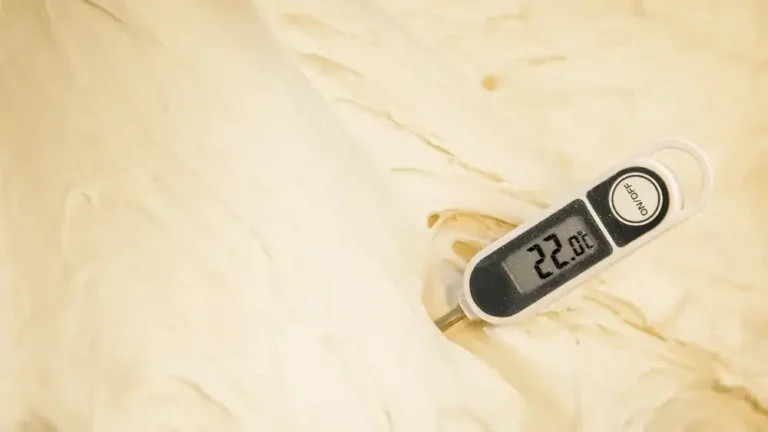
Calculating the Dough Temperature for Pizza
Dough temperature directly affects yeast activity: the optimum range is 25–30 °C. Soft doughs should reach about 27 °C after kneading, firmer …
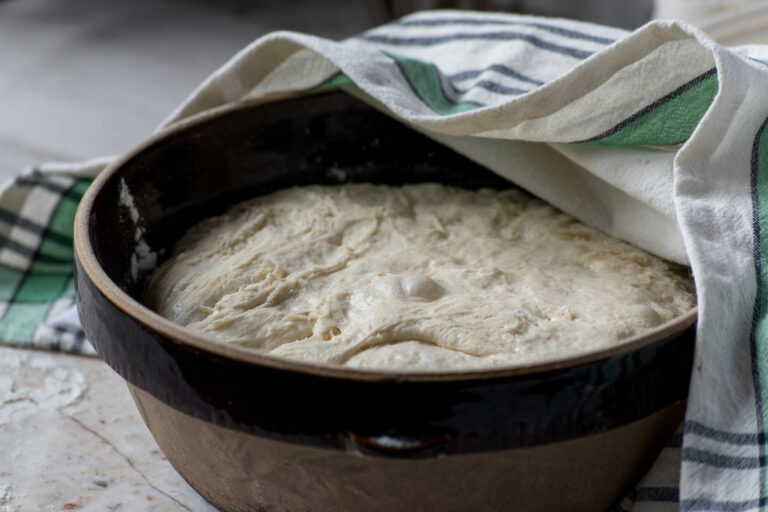
The Fermentation of Pizza: Why Is It So Important?
Fermentation gives pizza dough its lightness, texture and aroma. It is driven by yeast (Saccharomyces cerevisiae), which releases carbon dioxide that is …
 €15Voucher
Subscribe to our newsletter
Subscribe to our newsletter: courses, recipes and offers – plus €15 off your next order of €100 or more.
New · free
Calculate your pizza dough
Amounts, yeast and schedule for every style, in seconds. With a pro calculator for pizzerias.
Neapolitan · Pan · New York
Useful for this recipe
 DIE MODERNE pizza flour – special flour for pizza contemporanea | 10 kg sack19,90 €
- Regina flexible dough scraper for pizza dough balls | SPR-24 & SPR-25 Price range: 13,00 € through 15,50 €
- Dough ball box 40 × 30 × 10 cm for pizza dough, white and colours Price range: 10,90 € through 13,90 €
- Teiger Efficient Dough Residue Cleaning Cloth - Set of 219,00 €
- Regina stainless steel dough cutter and bench scraper | APC-11 Original price was: 15,00 €.12,50 €Current price is: 12,50 €.
- Lid for dough ball box 40 × 30 cm | Hygienic protection for pizza dough Price range: 9,50 € through 10,50 €


Pizza courses

Biga Basis Kurs - Professionelle Technik für Pizzateige 07.11.2026 | Samstagskurs
07.11.2026Only 2 places left


Leave a Reply